Recognising the Symptoms of Quinsy is a vital aspect of safeguarding your long-term health and maintaining the physical resilience required for your fitness goals. In this guide, I will provide you with clear, reliable information on identifying these symptoms, what you can expect during the recovery process, and exactly when to seek urgent medical support. Use this breakdown to stay informed and take decisive action if your throat health begins to compromise your daily performance.
Symptoms of quinsy
Understanding Peritonsillar Abscess
Quinsy, medically referred to as a peritonsillar abscess, is a collection of pus that gathers in the tissue adjacent to a tonsil. This condition typically emerges as a significant secondary complication of tonsillitis and can affect individuals across various age groups, unlike standard tonsillitis which is more frequently observed in paediatric patients.
Clinical Presentation and Common Indicators
The progression of symptoms usually occurs over the course of a few days. Patients may suffer from a variety of distressing signs, including:
- An intense and rapidly escalating sore throat, which is generally localised to one side.
- Significant difficulty or pain when swallowing (odynophagia).
- A distinct, muffled vocal change, often described as a „hot potato” voice.
- A noticeable lack of ease in opening the mouth (trismus).
- High temperature and fever.
- Aches or stiffness in the neck area.
- Swelling and sensitivity within the throat.
Factors Contributing to Development
While frequently linked to bacterial tonsillitis, other factors may contribute to the formation of an abscess in this region. Less common triggers include physical trauma to the throat, the presence of foreign objects, or underlying conditions such as syphilis or tuberculosis, which may create lesions leading to an abscess.
When to Seek Emergency Medical Attention
A quinsy is considered a medical emergency that requires prompt professional evaluation and, in many instances, surgical drainage by an ear, nose, and throat (ENT) specialist. You should contact emergency services (such as 999) or attend the nearest accident and emergency department immediately if you notice the following:
- Severe or worsening difficulty in breathing.
- A complete inability to swallow or manage saliva.
- A sore throat that deteriorates very quickly.
Please note that this text is for informational purposes only and does not serve as medical advice or a formal diagnosis. If you suspect you have an infection, contact your local general practitioner or health service provider.
Identifying the Primary Indicators of a Peritonsillar Abscess
The most immediate Symptoms of Quinsy include a severe, unilateral sore throat, significant difficulty swallowing, and a noticeable inability to open your mouth fully. As your body battles this bacterial complication, you will likely experience a persistent fever, bad breath, and a distinct ache that radiates into the ear on the side of the infection. These physical markers indicate that an abscess has formed between the tonsil and the throat wall, requiring prompt clinical assessment to prevent further escalation.
Early warning signs often manifest two to five days after an initial bout of tonsillitis, serving as a critical alert that your condition has progressed. You may notice your voice changing to a muffled „hot potato” tone and observe that your uvula has shifted from its central position. When these Symptoms of Quinsy appear, it is essential to monitor your breathing closely; if you feel your airway is becoming restricted, you must bypass standard appointments and dial 999 for emergency medical care immediately.
Distinguishing Quinsy from a Common Sore Throat
You can distinguish quinsy from a run-of-the-mill sore throat by the presence of intense, localized swelling and the mechanical obstruction of your jaw movement. While a standard throat infection might feel uncomfortable on both sides, quinsy is defined by a collection of pus that creates a one-sided, overwhelming pain that makes essential tasks like swallowing saliva nearly impossible. Ever found yourself wondering if it is just a rough cold, only to realise the pain is stuck on one side?
| Feature | Common Sore Throat | Quinsy |
|---|---|---|
| Pain Location | Usually bilateral | Strictly unilateral |
| Jaw Mobility | Normal | Trismus (restricted) |
| Voice | Hoarse | „Hot potato” muffled voice |
| Urgency | Self-limiting | Requires medical drainage |
Physical Signs of Quinsy in the Throat
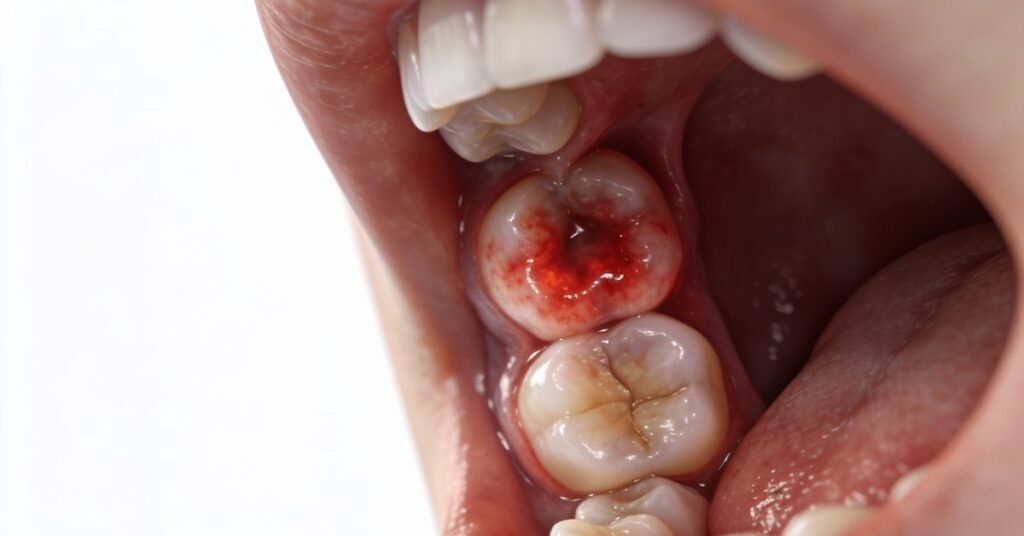
The physical signs of quinsy are characterised by visible inflammation and a significant limitation in jaw mobility known as Trismus. Clinically, Trismus is defined as the inability to open your mouth more than 3 cm, and in cases of quinsy, patients often struggle to open it even 1 cm. You will typically see a pus-filled pocket near the tonsil, accompanied by pronounced redness and swelling in the peritonsillar area, sometimes marked by a surface coating of white spots which signal a deep-seated bacterial infection.
These visible indicators are not merely surface-level discomforts; they are structural barriers that prevent normal nutrition and hydration. When you inspect your throat, look for the unilateral swelling that pushes the tonsil out of its natural alignment. Recognising these specific physical changes is essential for communicating your condition clearly to medical staff, ensuring they understand the severity of the obstruction you are facing.
When to Seek Emergency Medical Help
You must seek emergency medical help by calling 999 or visiting your nearest A&E if you experience extreme difficulty breathing, noisy breathing known as stridor, or a total inability to swallow saliva. These Symptoms of Quinsy suggest that the abscess is encroaching on your airway, which is a life-threatening scenario that requires immediate intervention. If you are struggling to speak coherently, this is another critical sign that your throat tissues are too swollen to function safely, and professional help is non-negotiable.
Remember: If your symptoms are worsening but you are not in immediate respiratory distress, you should follow these steps to manage the situation effectively:
- Contact NHS 111 for non-emergency but professional clinical guidance.
- Use the NHS 111 online service if you are unsure about the severity of your symptoms.
- Avoid self-medicating with heavy painkillers that might mask a worsening airway obstruction.
- Monitor your Symptom Duration and keep a log of any new difficulties, such as increased drooling.
Understanding the Recovery Timeline
Recovery from quinsy typically follows a structured path, with symptoms resolving within 5 to 7 days once appropriate medical treatment, such as surgical drainage or targeted antibiotics, has been administered. Most people experience an initial improvement in pain and swelling within the first 24 to 48 hours of starting treatment. I know from my own experience with health setbacks that the urge to jump back into the gym is strong, but you have to respect the recovery timeline to avoid a relapse.
While the initial infection phase may improve quickly, your body requires time to heal from the trauma of the abscess. Oral antibiotic courses usually last 1 to 2 weeks, and it is imperative that you finish the entire prescription, even if you feel significantly better after the first few days. I strongly recommend planning for 1 to 2 weeks of rest at home post-treatment; pushing yourself back into high-intensity training or a heavy workload too soon can hinder your recovery and leave you vulnerable to secondary health issues.
Frequently Asked Questions
Is quinsy contagious to others?
Quinsy itself is not contagious as it is a localized pus collection within your own tissues. However, the underlying bacterial tonsillitis that triggered the abscess can be transmissible via respiratory droplets.
Can I manage the pain with home remedies?
You cannot effectively manage quinsy with home remedies alone because it requires professional surgical drainage or antibiotics. Attempting to delay medical care can lead to serious complications or airway obstruction.
Why does my jaw feel locked?
Your jaw feels locked due to the inflammation of the muscles near the tonsils, a condition clinically termed Trismus. This is a direct response to the intense infection and swelling in the peritonsillar space.
Do I need surgery for this condition?
Many cases require a minor surgical procedure called incision and drainage to remove the accumulated pus. Your doctor will determine if this is necessary based on the size of the abscess and your clinical response to antibiotics.
Your ability to distinguish between standard inflammation and a deep-seated abscess will determine how safely and quickly you can return to your peak performance. Always prioritise a professional medical assessment over self-diagnosis the moment you notice any compromise in your breathing or swallowing.