Mastering the Jump Squats Exercise is a game-changer for anyone looking to build genuine explosive power, improve cardiovascular health, and tighten their physique through functional movement. In this guide, you will learn the precise mechanics to perform this exercise safely, how to avoid common pitfalls that lead to injury, and how to scale the movement to your specific fitness level. By following these evidence-based techniques, you will gain the confidence to push your body harder while ensuring your training remains both sustainable and effective.
Jump squats exercise
Understanding the mechanics of jump squats
Jump squats represent a high-intensity, plyometric movement designed to cultivate explosive power in the lower body while simultaneously increasing the heart rate. This exercise is particularly effective for engaging the quadriceps, gluteal muscles, hamstrings, and calves, making it a cornerstone for athletes aiming for greater speed and physical resilience.
Advantages for athletes
For individuals focused on running, jump squats are an invaluable asset. By teaching your muscle fibres to generate force rapidly, you improve your overall athletic performance and efficiency. Whether you are a beginner or a seasoned professional, mastering this technique helps in developing the necessary strength for high-impact movements.
Proper execution guide
Achieving the correct form is essential to prevent injury and maximise the benefits of the exercise. Follow these steps to perform a squat jump safely and effectively:
- Commence by standing tall, ensuring your feet are positioned at hip-width or shoulder-width apart.
- Point your toes slightly outward to encourage natural alignment.
- Maintain an upright posture, keeping your chest elevated and your core muscles engaged throughout the sequence.
- Shift your weight onto your heels, push your hips backward, and lower yourself as though sitting into a chair.
- Continue descending until your thighs are parallel to the floor, then initiate an explosive jump by driving through your midfoot.
- Land softly on the balls of your feet, immediately transitioning into the next repetition to maintain fluid motion.
Key form reminders
Consistency is vital when attempting this plyometric move. Always ensure that your back remains straight to avoid unnecessary strain on the spine. By focusing on quality over quantity, you will see significant improvements in your explosive capabilities and lower-body stability.
The Core Purpose of Jump Squats Exercise Training
The Jump Squats Exercise is primarily a high-intensity plyometric movement designed to build explosive lower-body power, muscular endurance, and cardiovascular capacity. By forcing your muscles to contract rapidly against gravity, this movement serves as a highly effective cardio alternative to steady-state running for those who want to shed fat while maintaining muscle mass. It is a versatile tool that can be performed without any equipment in the smallest of spaces, making it a staple for those who value efficiency in their fitness routine and want to optimise their daily caloric intake without spending hours in a commercial gym.
Mastering Perfect Jump Squats Exercise Technique
To perform a Jump Squats Exercise with proper form, follow these steps to ensure you’re moving like a pro rather than a novice who risks unnecessary strain on the knees or lower back:
- Starting position: Stand with feet shoulder-width apart and keep your knees slightly bent to maintain tension throughout the movement.
- The descent: Lower yourself into a full squat position, keeping your chest up and ensuring you go down low enough to maximise your range of motion.
- The explosion: Engage your quads, glutes, and hamstrings to propel your body upward, extending legs fully during the height of the jump.
- The landing: Ensure your feet leave the floor by at least a few inches, then land softly on the balls of your feet and immediately bend your knees to absorb the impact like a spring.
Muscles Targeted During the Jump Squats Exercise
The Jump Squats Exercise is a comprehensive compound movement that recruits almost every major muscle group in the lower body and core to generate force. The following table breaks down the primary and secondary muscle activation, illustrating why this move is often cited by strength coaches as a total-body developer:
| Muscle Group | Primary Function in Jump Squats Exercise |
|---|---|
| Quadriceps | Power generation during the initial jump phase |
| Glutes (Max/Med/Min) | Hip extension and explosive pelvic drive |
| Hamstrings/Calves | Stabilisation and force absorption on landing |
| Core | Mid-section rigidity and spinal alignment |
Common Form Mistakes and How to Avoid Them
Avoiding common errors is essential for injury prevention and maximising the effectiveness of your workout, as bad form is the fastest way to derail your progress. Ever found yourself feeling like your knees are doing the heavy lifting instead of your glutes? That’s usually a sign your hip engagement is off and you need to reset your focus.
- Knee alignment: Never let your knees cave inward, a condition known as valgus, or allow them to drift too far past your toes, which increases shear stress on the joint.
- Breathing: Inhale during the descent to brace your core, and exhale sharply as you explode upward to maximise force production.
- Landing mechanics: Avoid landing flat-footed or on your sole; always land on the balls of your feet to protect your ankles and shins from impact.
- Depth: Failing to go low enough is a common ego-check; ensure you hit a proper depth to keep the glutes fully involved in the lift.
Tailoring the Jump Squats Exercise to Your Fitness Level
Jump squats are highly adaptable, serving as basic agility drills for beginners or advanced power moves for experienced athletes. Important: This is an advanced dynamic power move that requires a complete warm-up to prepare your nervous system and connective tissues for the high-impact nature of the exercise. If you are just starting out, prioritise the quality of your landing over the height of your jump, as the eccentric phase—the descent—is where most of the muscle growth and tendon strengthening occurs.
| Level | Focus | Equipment |
|---|---|---|
| Beginner | Agility and form | Bodyweight only |
| Advanced | Power overload | Dumbbells or loop bands |
Incorporating the Jump Squats Exercise into Your Workout Routine
Integrating the Jump Squats Exercise into your regimen provides a robust challenge that builds explosiveness and cardiovascular health. From my experience, don’t try to go for a personal best in reps every day; treat it as a quality-over-quantity movement to keep your heart rate in the optimal zone without burning out your CNS. These are often used alongside jumping lunges and burpees as a superior alternative to traditional running. To see real progress, perform 3–4 sets of 10–15 repetitions as part of a high-intensity interval training session or as a standalone power-building drill to complement your heavy compound lifting.
Safety Tips and Precautions
Safety is the foundation of long-term progress, so focus on quality of movement rather than adding external weights prematurely. Remember: If you have any pre-existing health conditions, consult a doctor or physical therapist before starting this routine to ensure your joints are prepared for the dynamic load. It is critical to avoid knee valgus, and you should never lock out your knees at the top of the jump, as this transfers the force directly into the joint capsule rather than the surrounding musculature.
- Perform 3–4 sets of 10–15 repetitions per session.
- Never lock out your knees at the top of the jump or upon landing.
- Always roll back from the balls of your feet to your heels upon landing to absorb energy safely.
Advanced Variations to Enhance Your Results
You can manipulate the stimulus of the Jump Squats Exercise by introducing specific variations designed to recruit different muscle fibres and improve athletic output. Whether you are using dumbbell jump squats for resistance or seated box jumps to kill momentum, the goal is always to transfer raw strength into functional power. By placing a loop band around the thighs, you can force the gluteus medius to work overtime, enhancing hip stability. Finally, pairing heavy front squats at 80 to 85 percent intensity with broad jumps is an elite strategy to transfer raw strength into horizontal and vertical power development.
Frequently Asked Questions
Can I perform the Jump Squats Exercise if I have back pain?
You should consult a medical professional before starting if you have pre-existing spinal issues, as the impact from landing can aggravate lumbar discomfort. If cleared, start with shallow, controlled jumps to ensure your core remains braced throughout the entire movement.
What footwear is best for this plyometric drill?
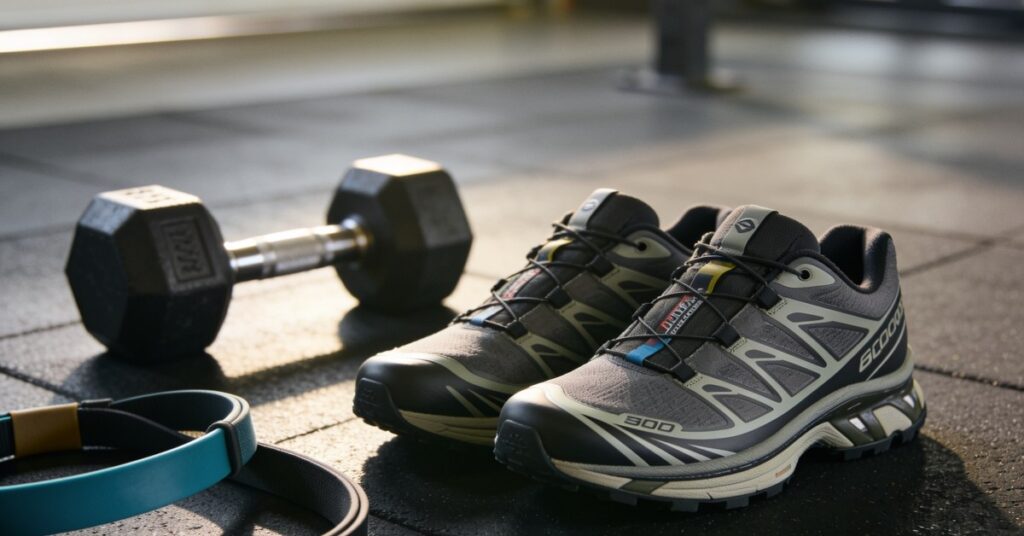
You need shoes that provide adequate arch support and impact absorption, such as cross-trainers or dedicated court shoes. Avoid running shoes with excessive heel cushioning, as they can make your landing unstable and increase the risk of rolling an ankle.
How long should I rest between sets of jump squats?
Because this is a power-based exercise, you should take 90 to 120 seconds of rest between sets to allow your ATP stores to replenish fully. This rest period ensures you can maintain maximum intensity and perfect form during every repetition.
How does this exercise compare to traditional weightlifting?
While traditional lifting focuses on building absolute strength, the Jump Squats Exercise builds rate of force development and explosive power. Integrating both methods is the most effective way to improve your overall athletic performance and functional ability in daily life.
Always prioritise a silent, controlled landing to protect your joints, knowing that even small, consistent improvements in your form will build the explosive power you are striving for.